
Marketing Strategy for founders.

Every founder I have worked with has struggled to answer “Why exactly should I choose your product?”
I’ve seen founders develop their product, design branding, create a website and launch social media accounts with no clarity on what makes it different from alternatives or who the product is really for. There is a gap between what the founder believes makes the product valuable and what customers recognise, or why they would choose the product over others.
If you're building a business and this sounds familiar, this approach was designed for you.
Intentional marketing creates demand and makes every decision easier
The default position is to think about marketing once it’s time to attract customers.
Entire product ranges, brand colours and logo are often created before thinking about it.
Marketing must start much earlier because it influences and guides what you create and who you create it for, the trade-offs to make, how to truly stand out, what to prioritise and what to ignore.
The problem with choosing colours, logo and identity before uncovering positioning and transformation for the audience is that it forces retrofitting after launch. We end up failing to help people understand why we are more relevant, more desirable, more trustworthy and more aligned with who they are instead of an alternative.
When marketing is intentional, you're not making random choices and hoping customers will care. You're making deliberate decisions based on what your audience values, recognises and wants to buy from the outset. And you save yourself heaps of time and money.
Here’s a simple example.
I worked with a spray oil startup that the farmer-founder developed for use with air fryers. As a healthier, higher quality product than most others on the market, he was sure of the problem he solved. And that was bringing him head-to-head with the market leader.
After interviewing customers, they all said they needed a light tasting low calorie 100% oil for all their frying needs. Current offerings were ruining their pans because they were blended oils with other ingredients. For them, a spray oil meant “ use for all kinds of cooking and not have to compromise on calories or taste”.
We determined that his spray oil was the everything oil, not just for air fryers. We captured customer feelings and sentiment, as well as their words and phrases. We identified the product's strengths and differentiators that the customer valued, which would make it easy for them to choose the brand over alternatives. The new positioning and messaging veered the brand away from direct comparison to the market leader because the meaning of the product changed.
Using marketing early on, before signing off on packaging, messaging and launch, makes the right decisions obvious and sets you apart from competitors. I’m going to explain how to do that next.
Social Media is not marketing, and you should never create content without a marketing strategy.
Social media is a relatively new channel in the marketing mix. We’ve just been trained by the internet to think it’s marketing.
When we skip marketing basics, the strategic foundations, and jump straight to posting and creating content, it’s like asking for marriage instead of a first date.
Just because we know what social media is about, or post on platforms, doesn’t mean we know HOW to do marketing that creates traction and sales.
The majority of founders are posting content on social platforms that does nothing to connect with the right people, create demand or grow their brand. Content creates interest, marketing creates momentum and sales.
Starting with content instead of audience and positioning is doing things backwards, creating burnout and wasting time and money for founders.
This is the sequence that’s been taught:
Idea → Product → Branding → Social Media & Content → Sales
Instead, we should be doing:
Audience → Insight → Positioning → Product → Messaging → Social Media & Content → Sales
This allows us to make decisions long before the first post is published, to ensure the right people sit up and take notice. It reduces confusion and overwhelm, making social media and creation more intentional and much easier.
The wiser way to use marketing to launch and grow your startup
Marketing should guide our decisions and positioning from day 1, so we target the right people, and they understand why they should choose us over alternatives. It should grow and shape the business from the beginning, not get bolted on at the end of the product creation process.
When I work with founders to put their marketing strategy in place, we do this in 6 steps using MAP.
MAP stands for Mindset, Audience, Message and Path to Purchase. Inside that, I use a 6-step process. It forces deep thinking and analysis to create consistent results.
Step 1. Mindful planning & goals
Most of us have too many ideas and so much spinning around in our heads. The process of honing what matters, defining goals and being honest about our limits is invaluable early on. Every founder’s journey is different. Some people are young, single and without a lot of personal responsibility, so they have all the time and energy in the world for this. Others are older, parents with time limits and dependants with less time, which dictates everything.
Tuning into “why” we’re starting this, our purpose, our founder's point of view, and the direction we want this to take, aligned with our personal lives, reduces so much of the mental load of starting.
Step 1 is about harnessing our ambition, putting structure to our thoughts, and getting long-term goals established to dictate business decisions.
Step 2. Define your audience & the reasons people buy
You’re not building for everyone. None of us can be all things to all people. You’re building for the people who’ll be most receptive to your product and the outcomes it delivers for them.
They will be a group of people with a similar worldview, shared characteristics and pain points. They could be old and young, but all in need of the same solution.
When we dive deep and understand in detail what people are looking for, their objections, problems and pain points, we start to understand their buying triggers, what resonates with them, what stops them from buying, but also what makes them feel seen and heard.
When we determined that customers for the spray oil wanted an everyday oil that worked for both air fryers and didn’t ruin frying pans, we ended up delivering a product that became more relevant for countless everyday cooking occasions and an everyday product.
Understanding people and the buying psychology relevant to your product and brand makes it possible to identify what they need to hear to buy and what objections and beliefs prevent them from buying from you, so you can address them head-on instead of guessing.
Don’t be afraid to spend the longest time interviewing people, researching Reddit and Quora threads, trawling competitor and Amazon reviews and finding any manner of ways to deeply understand buying decisions as opposed to asking ‘would you buy this?'. People will tell you they’ll buy, but often don’t. That’s why this step is dedicated to uncovering buying behaviours and experiences over personal opinions and empty promises.
Step 3: Unique positioning & voice: brand identity
Now is the time to uncover your unique differentiator and unique or contrarian point of view. Your positioning is the strategic space you hold in your target customers' minds, where they see you fit in the world. It also ensures you stand apart from your competitors. It answers ‘what do I want to be known for’.
Here’s where you uncover your strengths. What do your products uniquely offer vs competitors? If you didn’t exist, what alternatives would customers use instead? What does your product(s) enable your customers to feel or do that is valuable to them? Remember that a list of features is not the reason to care; it’s what the features can do and the outcomes they create that people care about.
When I created my snack brand, I didn’t differentiate strongly enough for the market I chose to compete in, hence I failed to get traction. Choosing where to compete and distribution channels dictates success or failure, as I learned.
When we uncover positioning, we also consider the point of view the brand will be known for. This usually aligns with the founder’s opinion or contrarian view of the market or category. Often, as founders, we want to shake up the status quo, go against the norm, or stand up for something. We capture that and use it to shape positioning and the brand statement.
Shaping a brand character and tone of voice ensures you express these beliefs and viewpoints, and how you solve a problem for the customer in a way that’s true to you and the brand.
There’sa 10-step checklist I walk through to create the brand identity, its character and personality, connecting to the transformation the customer will experience. You can access it here.
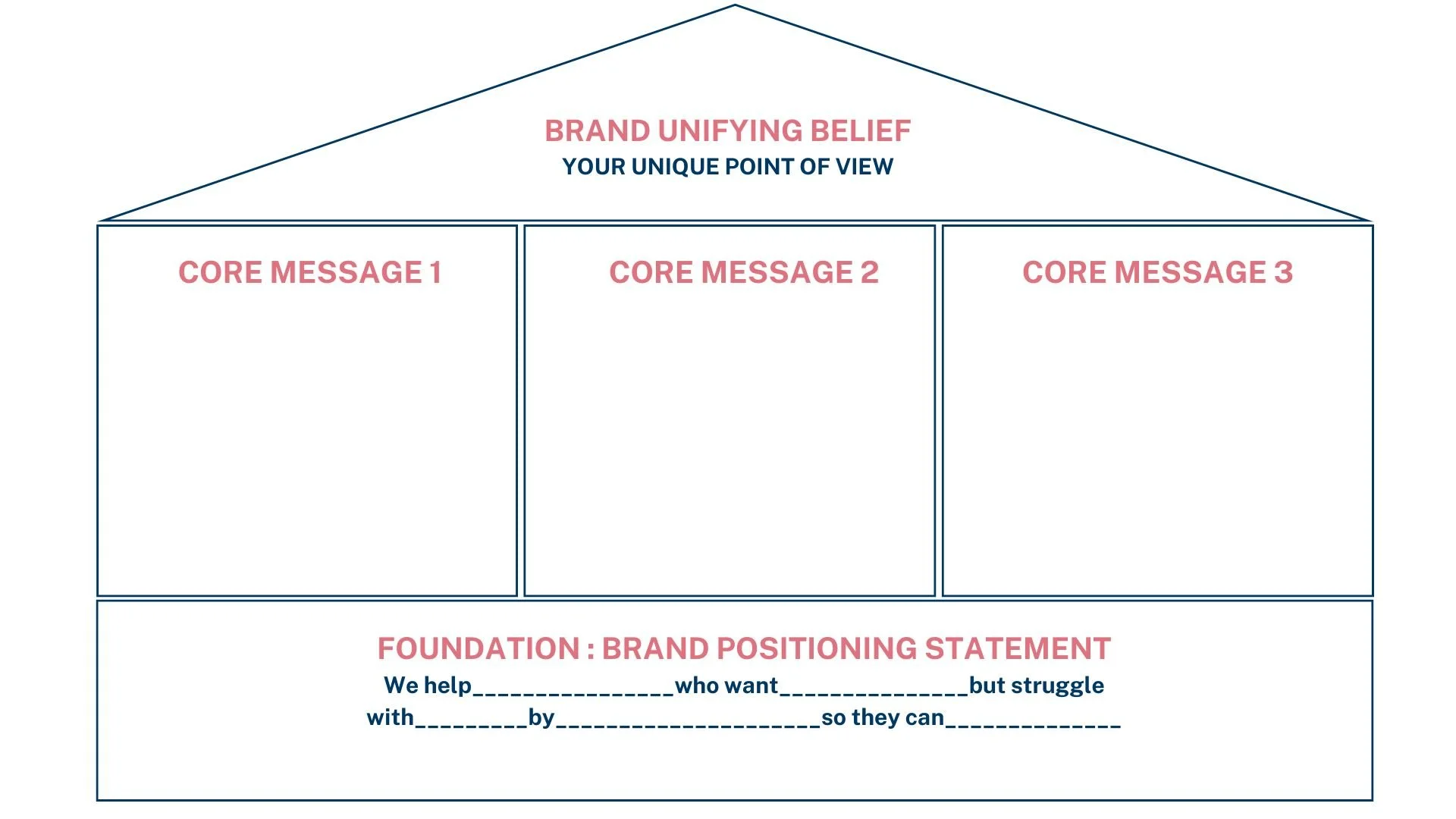
Step 4: Core language & Messaging House
You’ve now figured out your positioning, and you’re clear on your value and unique strengths, and the transformation you deliver to your customers. Your brand identity should represent what you stand for, and a tone of voice to match.
The next step is to define your core messaging and connect everything you’ve learned through your audience research to shape messages that will resonate with them.
For startups, this is critical. When you’re balancing multiple roles and functions at once, this keeps marketing and comms consistent and audience focused. There is no need to create new messaging every time, and tone, voice and value stay consistent every single time, so customers can’t get confused about what why they should buy and what they’re getting.
A messaging house is a powerful tool to do this. Here’s a template for you to complete.
Step 5: The Customer Journey (your funnel)
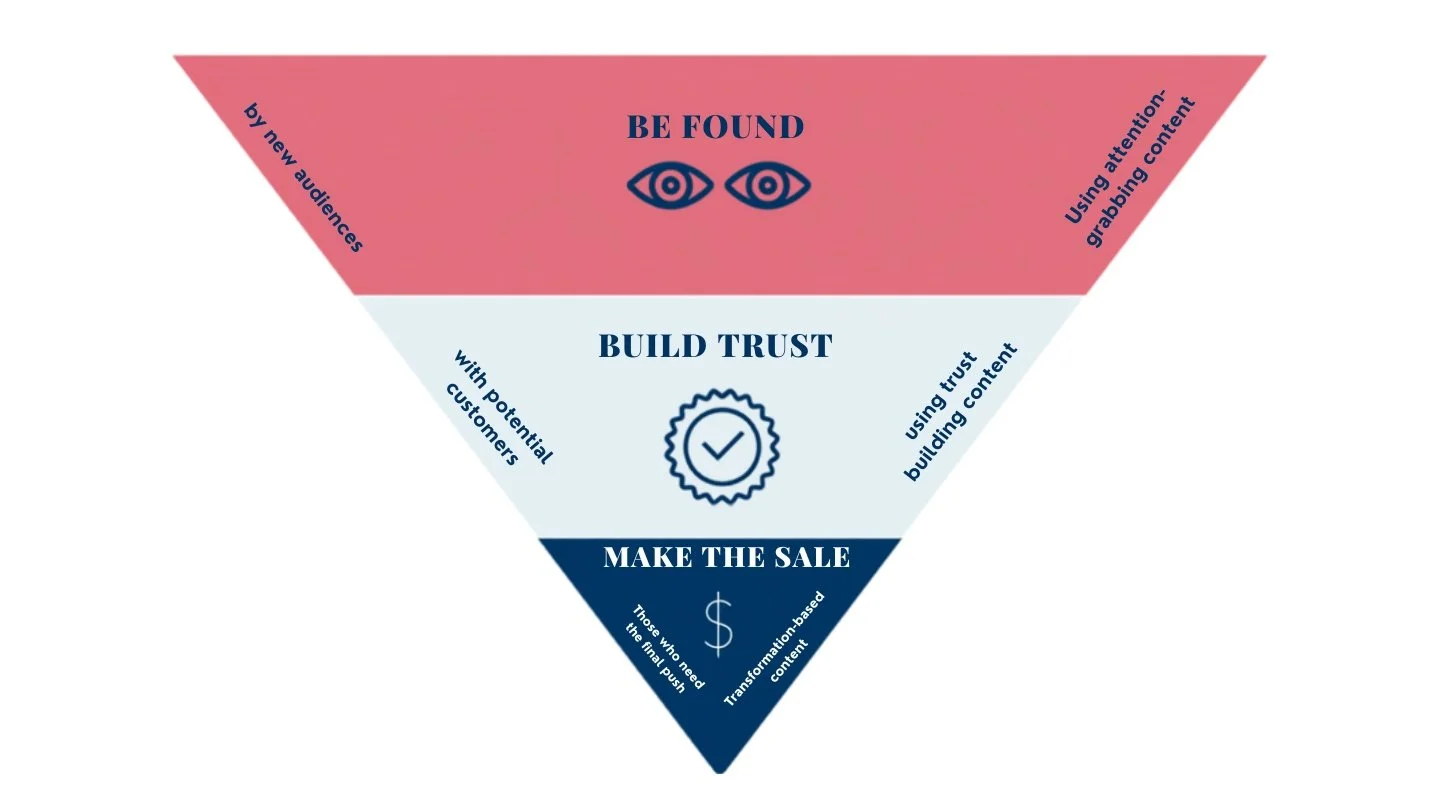
Now we’re getting to the part that the internet has made very confusing. Funnels are a map of your customer’s buying journey. Simply put, the journey they take from never having heard of you to clicking the buy button.
Understanding this sequence and what to say and show at each stage brings your marketing from educational/ attraction/ inspirational or polarising content right across to conversion content. The customer journey is a 3-part process so you will be making 3 types of content.
The point of a customer journey is to guide which content to create, which messages to dial up or down, and where to place specific types of content so you are either attracting, building trust or converting your target audience. Here’s what this looks like:
There will be key topics you identify, along with messages shaped by creating your messaging house. These are what you will talk about consistently across your content, in your brand tone of voice, and on which your content will be built.
Founders often start creating content on social platforms without ever having seen a customer journey or uncovering key messaging and topics their brand will be known for.
This is why content feels hard; it’s difficult to build momentum, and marketing becomes an overwhelming cycle of content creation instead of strategic marketing that actually attracts, connects and converts the right people.
The goal of step 5 is for you to create a system that makes content creation easier and guides your customer from the top (signalling value, attracting them) to the middle (sharing and building proof) and through to conversion (sales from raving fans)
Step 6: Use a Customer Journey to create a content strategy
Now you know how to uncover your positioning, have defined your messaging and customer’s journey, it’s time to shape a content strategy that fits your life.
So often I’ve seen founders burn out quickly from trying to create a volume of content they assumed was necessary. Or because that’s what the algorithm requires, or experts said it on Instagram.
The point of strategic marketing is to keep the lights on and your brand growing, no matter what an expert says or how the algorithm changes. The unique position and view you hold on the world will never change, your topics will never change, so your content will consistently attract and convert the right people, no matter what happens with a platform or channel.
The objective of any strategy is to allow you to distribute your marketing ANYWHERE your audience lives. Not to be at the mercy of outside influences or algorithm changes. It’s the format and method that change, not the message.
This last step is when you spend the time creating your plan of three different buckets of content, which platforms and where you will place your content, offline or online, your posting cadence and everything in between to make life and marketing easier, consistent and designed to create demand.
Getting started. It’s no big deal
Putting structure and intention behind marketing is fundamental to success and sanity. If you expect sales and traction by showing images of your product, sharing features and benefits, and simply showing up on platforms to be visible, then you’ll need to lower your expectations of what is possible.
Creating content is exactly that, and it makes you a content creator. Intentional marketing, delivered via social platforms, will instead create momentum, demand for your product and sales. I believe anyone can be a content creator, but not everyone can create marketing.
There’s a shift needed. To use marketing to shape and design everything from day 1 rather than turn to ‘marketing’ once product, design and packaging have been created. There is a dramatic, positive impact on the business when marketing leads, and guesswork and hope are eliminated
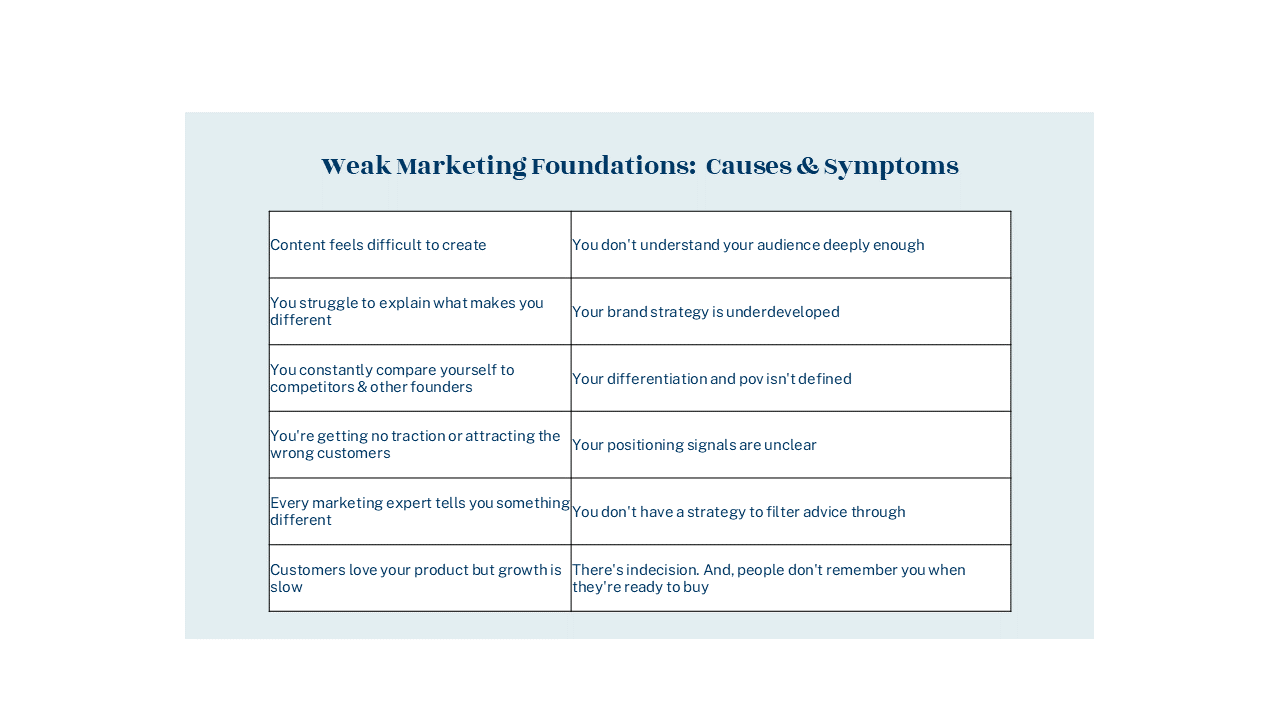
Here are some causes and symptoms of poor marketing foundations. If any of these resonate, you should get a marketing strategy using the MAP framework in place before it’s too late:
Do things in the right order. A template to kickstart your strategy
Doing the deep thinking now is good for a number of reasons…
1/ Instead of using marketing to sell something already created, you use marketing to help shape what’s relevant to your target audience, and save time and money in the long term.
2/ You discover what people care about. The language they use. The outcomes they want. The alternatives they're already considering. Most importantly, you uncover why they might choose you over every other option available to them.
3/ These insights influence your product, positioning, messaging, pricing and customer experience. They help you make better decisions long before money is spent on logos, websites, content and promotion.
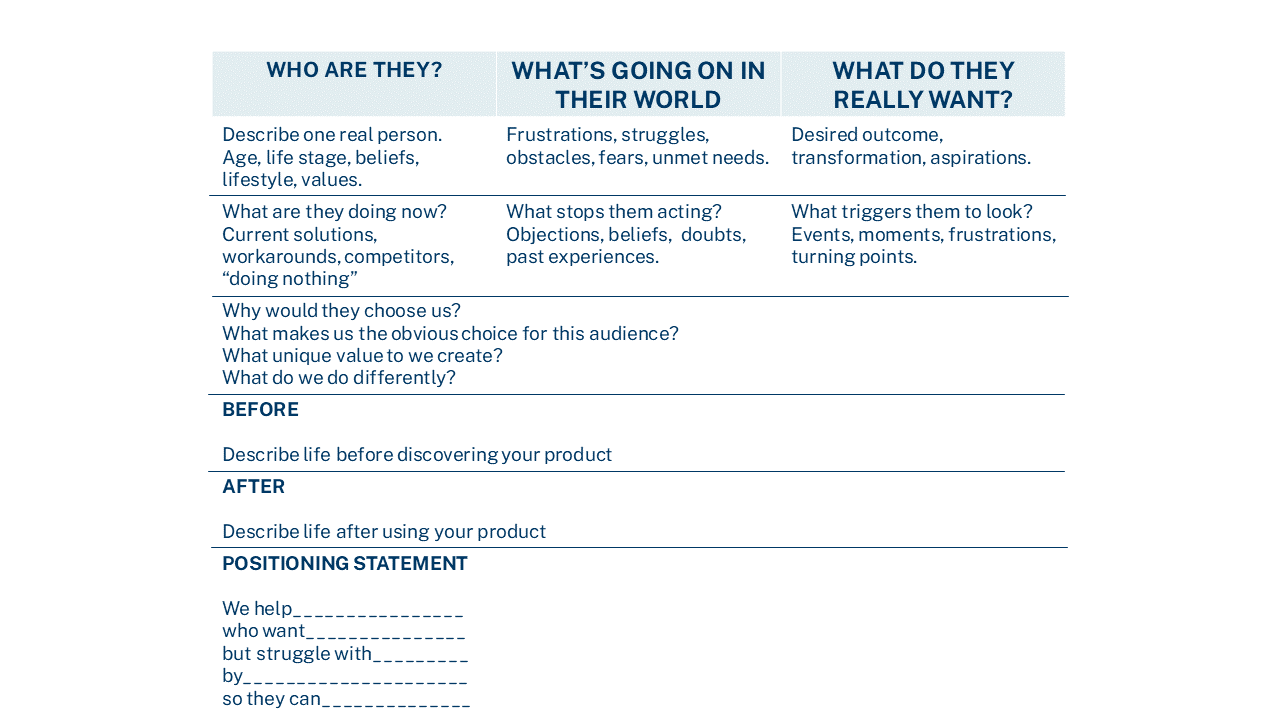
Here’s where I start with finding these insights and audience experiences. You can use this template to avoid the trap of demographics and shallow profiling. Getting into context, behaviours and the inner thoughts of our customers is far more revealing than topline facts.
Make it stand out
Whatever it is, the way you tell your story online can make all the difference.
Marketing is NOT showing up and creating content
Marketing is not about promotion and being seen. It’s the invisible boundary you put around your brand to filter out what’s not useful so you retain deep focus only on the activities, decisions, partners and opportunities that will grow the brand in the right direction.
It dictates every decision and trade-off you make from the early stages of your business, right through to successfully scaling. It creates momentum and sales. I find that once positioning, point of view and messaging are figured out, the confusion or concern around building demand disappears, and founders lean into and take ownership of their marketing with total confidence.
Is your marketing a bottleneck, or is it building a successful brand for you?
The point of marketing is to build your business and create demand from day 1. The point of this post is to help you put marketing at the centre of your business decisions so you position your brand as the obvious choice for your customers. The strategy you choose to create and put into action defines your brand for life. It acts as a north star and planner for your marketing activities, determining what you spend your time on and what you ignore. It’s a confidence tool and the gateway to becoming a marketer in your own right, fully in control and in charge of everything your brand does and doesn’t do. That releases time for other things and still creates sales through your content and interactions online and offline.
Done in the right order, a marketing strategy becomes your plan of action, led by your vision and your goals, so you achieve them and create sales consistently.